In many parts of the world, dating apps and social media have transformed how people meet potential partners. But in Shanghai, one of China’s most modern and fast-paced cities, an old-fashioned yet remarkably organized tradition continues to thrive — the “marriage market.” Here, parents gather in public parks carrying handwritten profiles of their adult children in the hope of finding suitable life partners for them.
For outsiders, the concept may appear surprising or even intrusive. However, within the Chinese social and cultural context, Shanghai’s marriage market reflects a complex mix of tradition, family expectations, economic realities, and changing modern lifestyles.
The phenomenon has become one of the most talked-about examples of how rapidly evolving societies still hold onto deep-rooted cultural values around marriage and family.
What Is Shanghai’s Marriage Market?
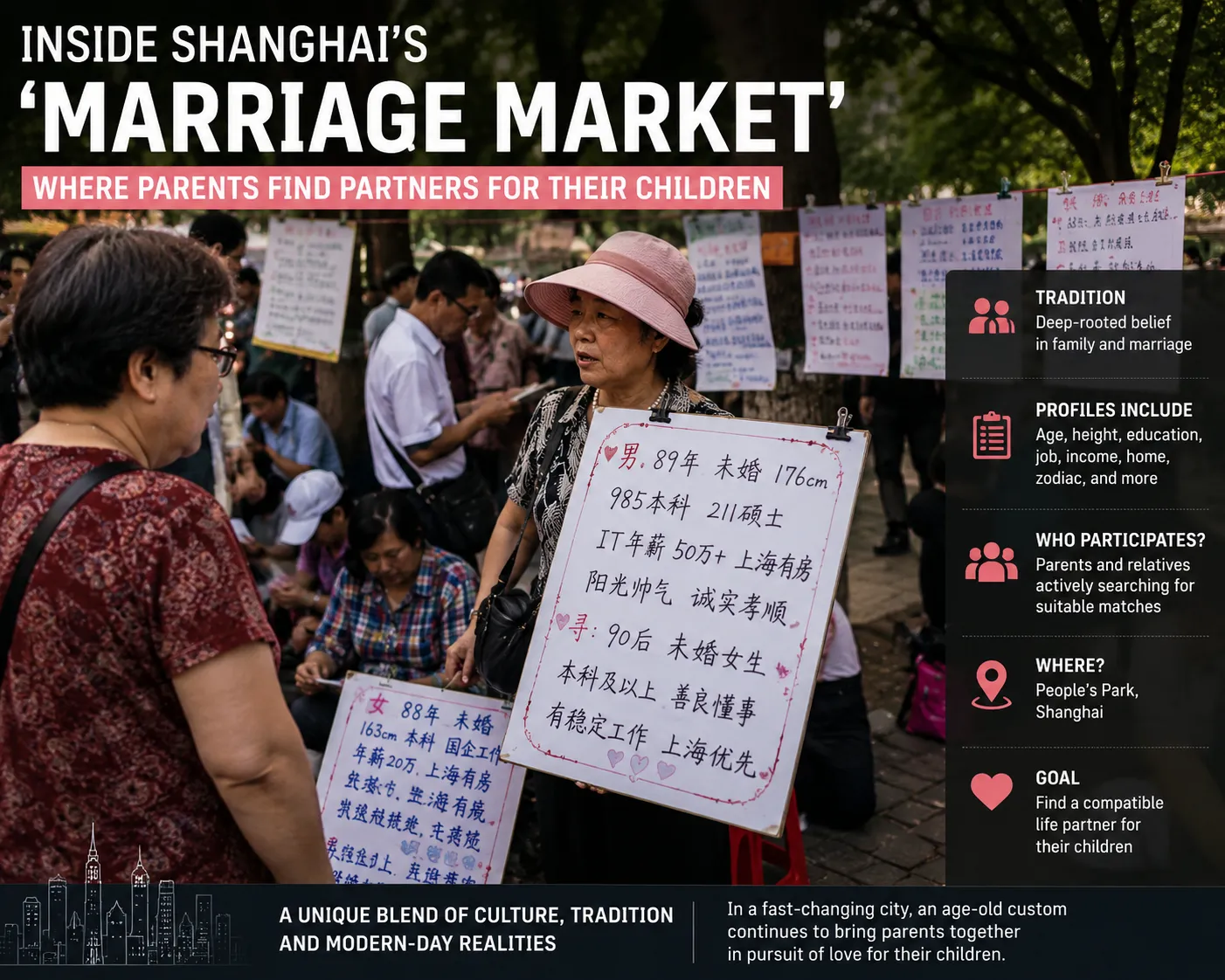
Shanghai’s marriage market is most famously associated with People’s Park, where parents regularly gather on weekends to exchange information about eligible bachelors and brides.
Instead of young people meeting directly, parents display detailed profiles of their children on umbrellas, posters, folders, or handwritten sheets.
These profiles typically include:
-
Age
-
Height
-
Education level
-
Occupation
-
Salary
-
Home ownership status
-
Zodiac sign
-
Hometown
-
Marital history
Some profiles even mention personality traits and expectations for a future partner.
Parents walk around the park, examine profiles, and initiate conversations with other families to determine compatibility.
The process resembles a mix between traditional matchmaking and a modern networking event.
Why the Marriage Market Exists
The marriage market did not emerge simply because parents enjoy controlling their children’s relationships. Instead, it reflects broader social and economic pressures within Chinese society.
1. Cultural Importance of Marriage
Marriage remains deeply valued in China, especially among older generations. Many parents see helping their children marry as both a responsibility and an important life goal.
In traditional Chinese culture, family continuity and stability are strongly connected to marriage and parenthood.
As a result, parents often feel personally invested in their children’s relationship status.
2. Pressure From Age Expectations
In China, there is still significant social pressure surrounding the “ideal” age for marriage.
Women in particular often face intense societal expectations. Unmarried women in their late twenties or thirties have sometimes been labeled with terms implying they are “leftover women,” though this phrase has faced increasing criticism in recent years.
Parents worried about their children remaining single may turn to marriage markets as a proactive solution.
3. Competitive Urban Lifestyles
Cities like Shanghai are known for demanding work cultures and long working hours. Many young professionals struggle to find time for traditional dating.
Career pressure, rising living costs, and fast-paced urban lifestyles can make building relationships difficult.
Parents sometimes believe the marriage market offers practical opportunities to connect families who share similar educational and financial backgrounds.
The Role of Parents in Chinese Matchmaking
Parental involvement in relationships is not unique to China, but the level of participation seen in marriage markets is particularly notable.
Many Chinese parents view marriage as a family matter rather than solely an individual choice.
Factors they often prioritize include:
-
Financial stability
-
Education level
-
Family background
-
Career prospects
-
Property ownership
In highly competitive urban environments, these criteria are often seen as indicators of long-term security.
This practical approach to matchmaking may appear transactional to outsiders, but supporters argue it reflects realistic concerns about future stability.
How Young People Feel About It
The attitudes of younger generations toward marriage markets are mixed.
Some Feel Embarrassed
Many young professionals feel uncomfortable with their parents publicly advertising their personal details.
Some argue that the practice:
-
Invades privacy
-
Creates unnecessary pressure
-
Reduces relationships to statistics and financial qualifications
Others Appreciate the Effort
Some individuals, however, understand their parents’ intentions and view the process as an expression of care and concern.
In some cases, young people even allow their parents to participate willingly because they trust family judgment.
The generational divide often reflects changing attitudes toward love, independence, and marriage in modern China.
Love Versus Practicality
One of the most fascinating aspects of Shanghai’s marriage market is the balance between romance and practicality.
Western dating culture often emphasizes:
-
Emotional chemistry
-
Shared interests
-
Romantic attraction
The marriage market, however, frequently prioritizes:
-
Financial security
-
Educational compatibility
-
Social stability
-
Long-term practicality
Critics argue that this approach risks reducing human relationships to checklists and economic calculations.
Supporters counter that practical compatibility is essential for lasting marriages.
The debate reflects broader cultural differences in how relationships are viewed across societies.
The Economic Side of Marriage
Economic realities play a major role in China’s modern dating landscape.
Housing prices in major cities like Shanghai are extremely high, making financial stability a major concern for families.
In many cases:
-
Property ownership significantly affects marriage prospects
-
High-income professions are highly valued
-
Financial security becomes part of relationship negotiations
This economic pressure influences both parents and young adults.
Marriage markets therefore function not only as social spaces but also as reflections of broader economic anxieties within urban China.
Changing Attitudes Among Younger Generations
China’s younger generations are increasingly reshaping traditional relationship norms.
Many young people now prioritize:
-
Personal freedom
-
Career development
-
Emotional compatibility
-
Delayed marriage
-
Individual happiness
This shift has created tension between traditional family expectations and modern personal values.
As education levels rise and urbanization increases, younger adults are becoming more independent in their relationship choices.
However, parental influence still remains strong in many families.
The Influence of Technology and Dating Apps
Like the rest of the world, China has also experienced a boom in online dating platforms and matchmaking apps.
Young adults increasingly use digital tools to meet potential partners independently.
Yet despite the popularity of technology, marriage markets continue to exist.
This coexistence highlights an interesting contrast:
-
Young people often prefer digital dating
-
Older generations continue trusting traditional matchmaking methods
In some ways, marriage markets and dating apps serve similar goals — they both attempt to organize and simplify partner selection.
The difference lies mainly in who controls the process.
Tourist Attraction and Global Curiosity
Shanghai’s marriage market has also become an international curiosity.
Tourists and foreign media frequently visit People’s Park to observe the matchmaking culture firsthand.
The sight of hundreds of parents holding marriage profiles in a public park often surprises international visitors.
However, many sociologists argue that the practice should not simply be viewed as unusual or outdated. Instead, it reflects:
-
Cultural traditions
-
Economic pressures
-
Family-centered values
-
Rapid societal transformation
Understanding the marriage market requires viewing it within China’s broader social context.
A Reflection of Modern China
Shanghai’s marriage market represents the intersection of old traditions and modern realities.
It reveals:
-
The enduring importance of family in Chinese society
-
Economic pressures influencing relationships
-
Generational differences in attitudes toward marriage
-
The challenges of balancing tradition with modern independence
As China continues evolving socially and economically, these marriage markets may also transform.
Some experts believe they could gradually decline as younger generations become more independent. Others argue they will survive in new forms because family involvement remains deeply rooted in Chinese culture.
Conclusion
Shanghai’s marriage market is far more than a public matchmaking event. It is a powerful reflection of cultural values, social expectations, economic pressures, and generational change in modern China.
While some see the practice as overly traditional or intrusive, others view it as a practical and family-oriented approach to helping loved ones find stability and companionship.
In an era dominated by dating apps and digital communication, the continued existence of these marriage markets demonstrates that technology does not completely erase cultural traditions. Instead, societies often blend old customs with modern realities in unique ways.
Ultimately, Shanghai’s marriage market tells a deeper story — not just about marriage, but about how families, culture, and changing social values continue shaping human relationships in the modern world.
iodailynews.com iodailynews.com iodailynews.com iodailynews.com iodailynews.com iodailynews.com iodailynews.com iodailynews.com iodailynews.com iodailynews.com iodailynews.com iodailynews.com iodailynews.com iodailynews.com iodailynews.com iodailynews.com iodailynews.com iodailynews.com iodailynews.com iodailynews.com iodailynews.com iodailynews.com iodailynews.com iodailynews.com iodailynews.com iodailynews.com iodailynews.com iodailynews.com iodailynews.com iodailynews.com iodailynews.com iodailynews.com iodailynews.com iodailynews.com iodailynews.com iodailynews.com iodailynews.com iodailynews.com iodailynews.com iodailynews.com iodailynews.com iodailynews.com iodailynews.com iodailynews.com iodailynews.com iodailynews.com iodailynews.com iodailynews.com iodailynews.com iodailynews.com iodailynews.com iodailynews.com iodailynews.com iodailynews.com iodailynews.com iodailynews.com iodailynews.com iodailynews.com iodailynews.com iodailynews.com iodailynews.com iodailynews.com iodailynews.com iodailynews.com iodailynews.com iodailynews.com iodailynews.com iodailynews.com iodailynews.com iodailynews.com iodailynews.com iodailynews.com iodailynews.com iodailynews.com iodailynews.com iodailynews.com iodailynews.com iodailynews.com iodailynews.com iodailynews.com iodailynews.com iodailynews.com iodailynews.com iodailynews.com iodailynews.com iodailynews.com iodailynews.com iodailynews.com iodailynews.com iodailynews.com iodailynews.com iodailynews.com iodailynews.com iodailynews.com iodailynews.com iodailynews.com iodailynews.com iodailynews.com iodailynews.com iodailynews.com iodailynews.com iodailynews.com iodailynews.com iodailynews.com iodailynews.com iodailynews.com iodailynews.com iodailynews.com iodailynews.com iodailynews.com iodailynews.com iodailynews.com iodailynews.com iodailynews.com iodailynews.com iodailynews.com iodailynews.com iodailynews.com iodailynews.com iodailynews.com iodailynews.com iodailynews.com iodailynews.com iodailynews.com iodailynews.com iodailynews.com iodailynews.com iodailynews.com iodailynews.com iodailynews.com iodailynews.com iodailynews.com iodailynews.com iodailynews.com iodailynews.com iodailynews.com iodailynews.com iodailynews.com iodailynews.com iodailynews.com iodailynews.com iodailynews.com iodailynews.com iodailynews.com iodailynews.com iodailynews.com iodailynews.com iodailynews.com iodailynews.com iodailynews.com iodailynews.com iodailynews.com iodailynews.com iodailynews.com iodailynews.com iodailynews.com iodailynews.com iodailynews.com iodailynews.com iodailynews.com iodailynews.com iodailynews.com iodailynews.com iodailynews.com iodailynews.com iodailynews.com iodailynews.com