The Tamil film industry has lost one of its most influential storytellers with the passing of veteran filmmaker, actor, writer, and screenwriter K. Bhagyaraj, who died in Chennai on June 27 at the age of 73 following a cardiac arrest. His death comes just weeks after the passing of his mentor, legendary filmmaker Bharathiraja, marking another profound loss for Indian cinema. Bhagyaraj’s demise has prompted an outpouring of tributes from actors, directors, writers, and fans who remember him as a filmmaker whose stories reflected the hopes, struggles, and aspirations of ordinary people.
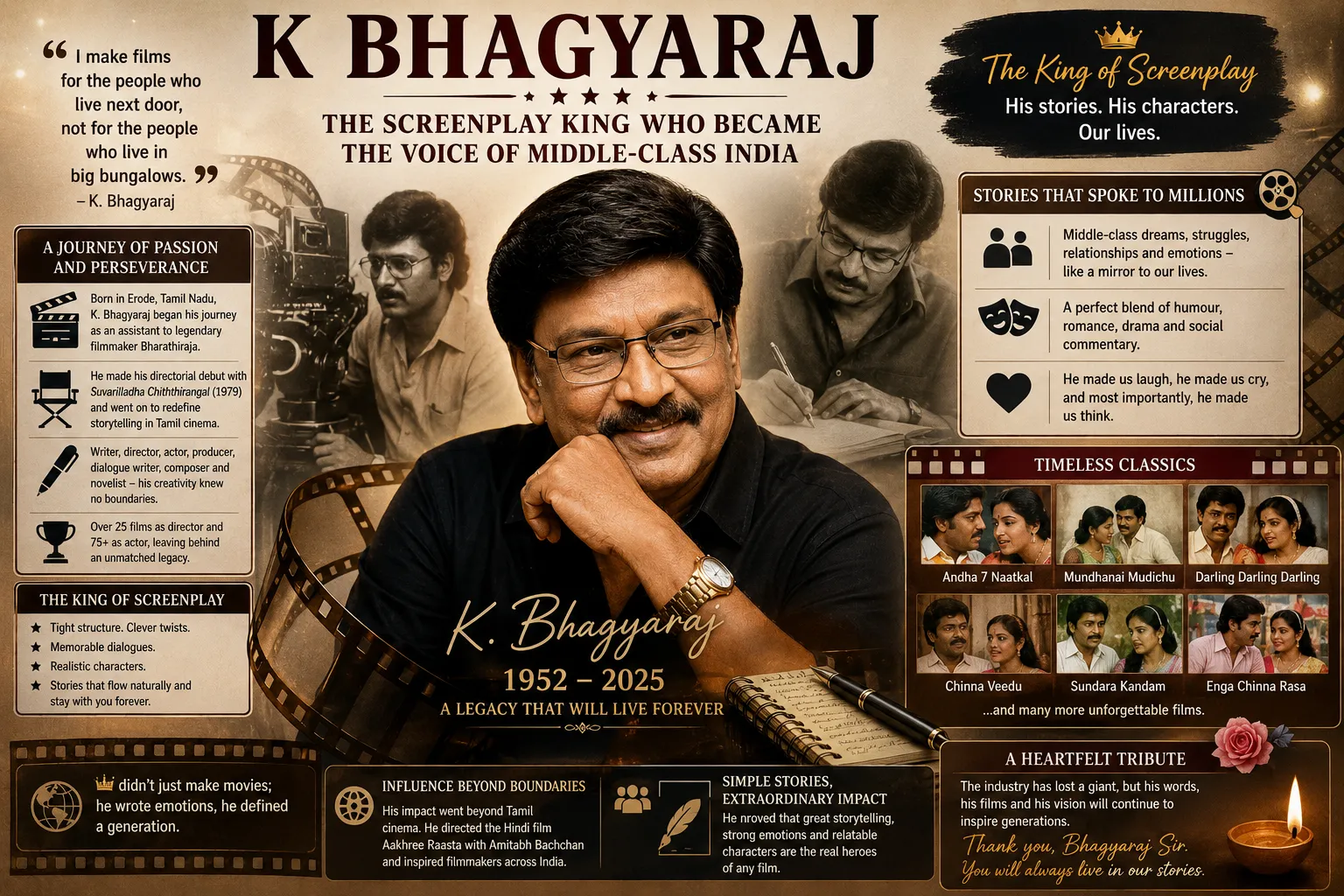
Often referred to as the “King of Screenplay,” Bhagyaraj transformed Tamil cinema through his distinctive storytelling style. His films combined humour, emotion, romance, and social commentary while portraying middle-class life with remarkable authenticity. Unlike many commercial filmmakers of his era, he created characters that audiences could relate to, making him one of the most celebrated writer-directors in Indian cinema.
A Journey That Began Under Bharathiraja
Born as Krishnaswamy Bhagyaraj in Tamil Nadu’s Erode district, Bhagyaraj entered the film industry with modest beginnings. He started his career as an assistant to acclaimed filmmaker Bharathiraja, learning the craft of filmmaking by observing one of Tamil cinema’s greatest directors.
Working closely with Bharathiraja allowed Bhagyaraj to understand every aspect of filmmaking, from screenplay writing and character development to direction and visual storytelling. This experience laid the foundation for a career that would eventually redefine screenplay writing in Tamil cinema.
He later made his directorial debut with Suvarilladha Chiththirangal in 1979 and quickly established himself as a filmmaker with a unique narrative voice.
The Rise of the “Screenplay King”
While many directors gained recognition for visual style or technical innovation, Bhagyaraj earned admiration primarily for his writing.
His screenplays were known for their tight structure, clever twists, memorable dialogues, and realistic characters. Every scene served a purpose, and his stories flowed naturally without unnecessary distractions.
Industry professionals frequently cited Bhagyaraj’s films as examples of effective screenplay construction. His ability to balance comedy, romance, family drama, and suspense within a single narrative became his trademark.
This remarkable consistency earned him the title “King of Screenplay,” a recognition that remained associated with him throughout his career.
Giving Middle-Class India a Voice
Perhaps Bhagyaraj’s greatest contribution was his portrayal of ordinary families.
Instead of focusing on larger-than-life heroes, he built stories around teachers, office workers, young lovers, struggling husbands, housewives, and families dealing with everyday challenges.
His characters worried about finances, relationships, marriage, education, misunderstandings, and social expectations—the same concerns experienced by millions of middle-class Indians.
Because his films reflected familiar situations, audiences developed an emotional connection with his storytelling.
His cinema demonstrated that extraordinary entertainment could emerge from ordinary lives.
A Master of Humour and Emotion
Bhagyaraj possessed a rare ability to combine comedy with meaningful storytelling.
His humour never relied solely on slapstick or exaggerated situations. Instead, much of it emerged naturally from character interactions and everyday misunderstandings.
Even while making audiences laugh, he explored themes such as family relationships, personal responsibility, social expectations, gender roles, and emotional maturity.
This balance between entertainment and substance helped his films appeal to viewers across generations.
Many of his stories continue to be appreciated decades after their original release because they remain emotionally relevant.
Iconic Films That Defined an Era
Over a career spanning nearly five decades, Bhagyaraj directed more than 25 films and acted in over 75 productions. His filmography includes several classics that continue to enjoy popularity among audiences.
Some of his most celebrated works include Andha 7 Naatkal, Mundhanai Mudichu, Darling Darling Darling, Chinna Veedu, Sundara Kandam, and Enga Chinna Rasa.
These films showcased his remarkable understanding of human relationships while demonstrating his exceptional screenplay writing skills.
Many of them remain reference points for aspiring filmmakers studying narrative structure and character development.
More Than a Director
Bhagyaraj was far more than a filmmaker.
Throughout his career, he worked successfully as an actor, screenwriter, producer, dialogue writer, composer, and novelist.
He frequently wrote, directed, and starred in his own films, giving him complete creative control over the storytelling process.
This rare combination allowed him to maintain consistency in tone, characterization, and screenplay execution.
Few filmmakers have demonstrated such versatility across multiple creative disciplines.
Influence Beyond Tamil Cinema
Although Bhagyaraj became synonymous with Tamil cinema, his influence extended well beyond the regional film industry.
His storytelling techniques inspired filmmakers across India, particularly those interested in family-oriented dramas and screenplay-driven narratives.
He also directed the Hindi film Aakhree Raasta, starring Amitabh Bachchan, introducing his screenplay sensibilities to a wider national audience.
His success demonstrated that strong writing could transcend language barriers.
Several filmmakers have acknowledged Bhagyaraj’s influence on their understanding of screenplay construction and character-driven storytelling.
A Mentor to Future Talent
Bhagyaraj also played an important role in nurturing new talent.
Over the years, he introduced several actors and technicians to the industry while mentoring aspiring filmmakers interested in screenwriting.
His willingness to share knowledge earned him respect not only as a filmmaker but also as a teacher.
Many young directors studied his films to understand pacing, dialogue writing, and audience engagement.
His contribution therefore extends beyond his own films to the generations of storytellers influenced by his work.
A Legacy Rooted in Simplicity
One of Bhagyaraj’s defining qualities was his ability to transform simple ideas into compelling cinema.
He proved that strong emotions, believable characters, and intelligent writing often resonate more deeply than extravagant budgets or visual spectacle.
His stories rarely depended on elaborate action sequences or special effects.
Instead, they relied upon carefully written situations that reflected real human experiences.
This storytelling philosophy continues to influence writers and directors seeking authenticity in commercial cinema.
Tributes from the Film Industry
Following news of his passing, tributes poured in from across the Indian film fraternity.
Actors, directors, producers, and screenwriters described Bhagyaraj as a creative genius whose contribution to Indian cinema would remain timeless.
Many highlighted his unmatched screenplay skills, while others remembered his humility, generosity, and commitment to storytelling.
His death has left a significant void in Tamil cinema, especially coming so soon after the loss of Bharathiraja, the filmmaker who first introduced him to the industry.
Why Bhagyaraj’s Work Still Matters Today
Even in today’s era of digital streaming and large-scale productions, Bhagyaraj’s films continue to offer valuable lessons.
His work reminds filmmakers that audiences connect most deeply with authentic characters and emotionally honest storytelling.
His screenplays demonstrate that successful cinema does not necessarily require complexity. Instead, clarity, strong structure, and relatable emotions often create the most lasting impact.
Film schools and aspiring writers continue studying his narrative techniques because they remain remarkably relevant despite changing cinematic trends.
Conclusion
K. Bhagyaraj’s passing marks the end of one of Tamil cinema’s most remarkable creative journeys. For nearly five decades, he entertained audiences not through spectacle alone but through intelligent writing, memorable characters, and stories rooted in everyday life. His ability to capture the emotions, humour, and struggles of middle-class families earned him a unique place in Indian cinema and the enduring title of the “Screenplay King.”
Although the film industry has lost one of its finest storytellers, Bhagyaraj’s legacy lives on through the timeless films he created, the filmmakers he inspired, and the countless viewers who continue to find themselves reflected in his stories. His contribution goes far beyond cinema—it represents an era when honest storytelling, thoughtful screenplays, and relatable characters became the true heroes of the silver screen.
roystonhotel roystonhotel roystonhotel roystonhotel roystonhotel roystonhotel roystonhotel roystonhotel roystonhotel roystonhotel roystonhotel roystonhotel roystonhotel roystonhotel roystonhotel roystonhotel roystonhotel roystonhotel roystonhotel roystonhotel roystonhotel roystonhotel roystonhotel roystonhotel roystonhotel roystonhotel roystonhotel roystonhotel roystonhotel roystonhotel roystonhotel roystonhotel roystonhotel roystonhotel roystonhotel roystonhotel roystonhotel roystonhotel roystonhotel roystonhotel roystonhotel roystonhotel roystonhotel roystonhotel roystonhotel roystonhotel roystonhotel roystonhotel roystonhotel roystonhotel roystonhotel roystonhotel roystonhotel roystonhotel roystonhotel roystonhotel roystonhotel roystonhotel roystonhotel roystonhotel roystonhotel roystonhotel roystonhotel roystonhotel roystonhotel roystonhotel roystonhotel roystonhotel roystonhotel roystonhotel roystonhotel roystonhotel roystonhotel roystonhotel roystonhotel roystonhotel roystonhotel roystonhotel roystonhotel roystonhotel roystonhotel roystonhotel roystonhotel roystonhotel roystonhotel roystonhotel roystonhotel roystonhotel roystonhotel roystonhotel roystonhotel roystonhotel roystonhotel roystonhotel roystonhotel roystonhotel roystonhotel roystonhotel roystonhotel roystonhotel roystonhotel roystonhotel roystonhotel roystonhotel roystonhotel roystonhotel roystonhotel roystonhotel roystonhotel roystonhotel roystonhotel roystonhotel roystonhotel roystonhotel roystonhotel roystonhotel roystonhotel roystonhotel roystonhotel roystonhotel roystonhotel roystonhotel roystonhotel roystonhotel roystonhotel roystonhotel roystonhotel roystonhotel roystonhotel roystonhotel roystonhotel roystonhotel roystonhotel roystonhotel roystonhotel roystonhotel roystonhotel roystonhotel roystonhotel roystonhotel roystonhotel roystonhotel roystonhotel roystonhotel roystonhotel roystonhotel roystonhotel roystonhotel roystonhotel roystonhotel roystonhotel roystonhotel roystonhotel roystonhotel roystonhotel roystonhotel roystonhotel roystonhotel roystonhotel roystonhotel roystonhotel roystonhotel roystonhotel roystonhotel roystonhotel roystonhotel roystonhotel